Search has fundamentally shifted. With AI-driven systems (Google SGE, ChatGPT search, Perplexity, Gemini, voice assistants) becoming primary touchpoints, traditional SEO alone is no longer sufficient. This is where Answer Engine Optimization , becomes the new frontier.
AEO focuses on structuring, optimizing, and delivering content in a way that enables AI models and search engines to understand, extract, and present answers instantly.
This article breaks down AEO through technical SEO, content strategy, information architecture, and entity optimization, along with a practical example on creating AEO-ready content.
1. What Is AEO (Answer Engine Optimization)?
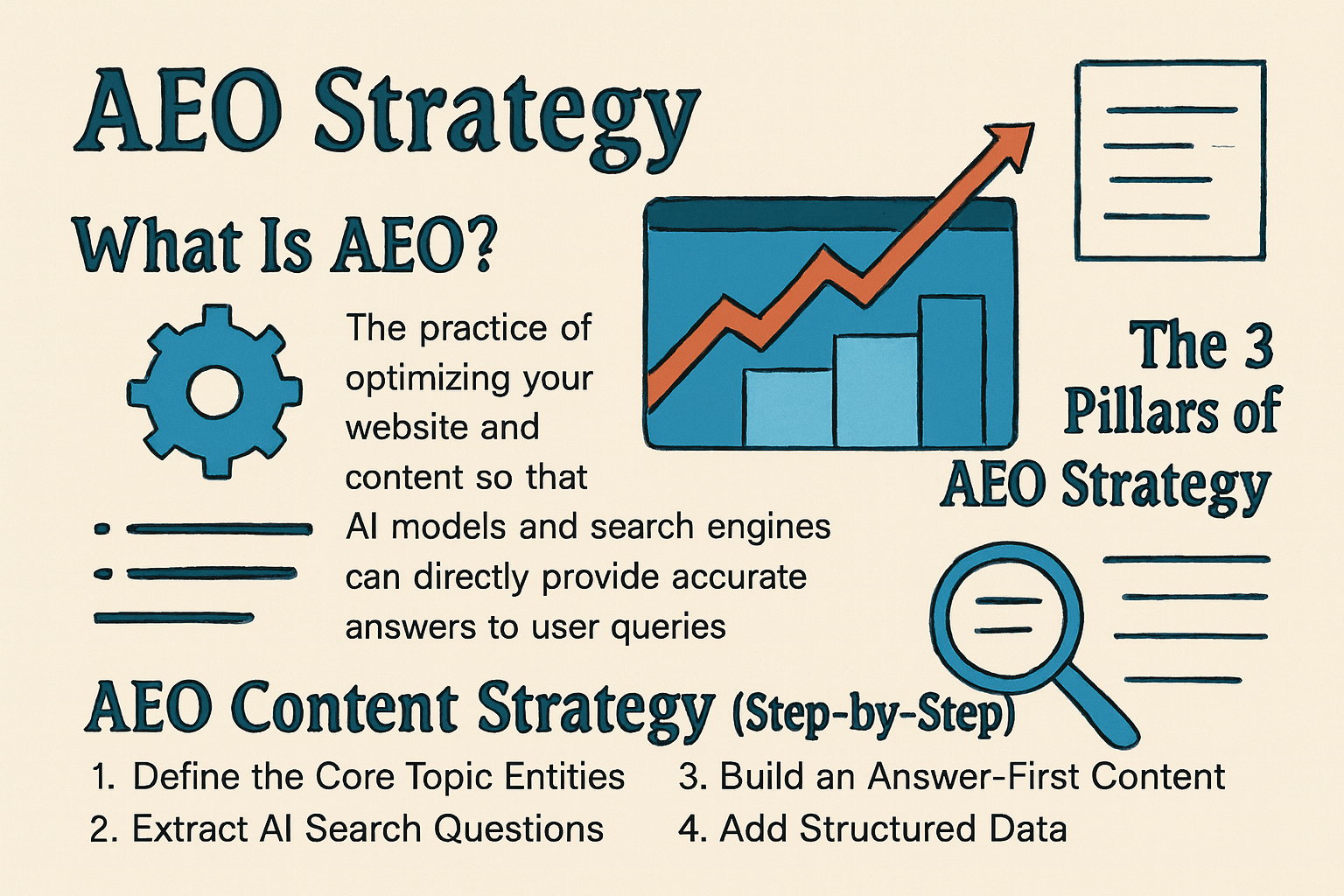
AEO as stated in my earlier post on "how to Mastering AEO" is the practice of optimizing your website and content so that AI models and search engines can directly provide accurate answers to user queries — especially in:
- AI Overviews (Google SGE)
- Chat-based search (ChatGPT Search, Perplexity)
- Voice assistants (Siri, Alexa, Google Assistant)
- Featured snippets / Knowledge Panels
- Zero-click SERPs
Traditional SEO vs AEO
| Traditional SEO | AEO Tactics |
| Ranking on SERPs | Being the source of the AI-generated answer |
| Keyword targeting | Query intent + entity mapping |
| Long-form pages | Concise, structured, answer-ready content |
| Human audience | Human + AI model audience |
| Ranking factors | Ranking + extraction + trust signals |
2. The 3 Pillars of AEO Strategy
AEO success depends on three interconnected pillars:
Pillar 1: Technical AEO (Technical + Structured SEO)
a) Schema Markup & Entity Linking
AI models identify and map content using structured data. At minimum your site must have:
- FAQ schema
- How-To schema
- Product schema
- Organization & LocalBusiness schema
- Article schema
- Breadcrumb schema
Also ensure:
- Internal entity linking
- Consistent NAP data for brands/services
- Maintain a brand knowledge graph (Wikipedia, Wikidata, Google Business Profile, LinkedIn, Crunchbase)
b) Crawlability & Site Speed
Answer engines prioritize pages they can quickly crawl and parse.
Focus on:
- Core Web Vitals (LCP <2.5s, CLS <0.1, INP <200ms)
- Simple HTML structure
- Removing script-heavy layouts
- Clear headers (H1, H2, H3 hierarchy)
c) Content Chunking & Modular Design
AI needs predictable structure.
Use:
- Short paragraphs (30–50 words)
- Bullet lists
- Semantic headings
- Data tables
- Definition blocks
AI parsers love uniform content.
Pillar 2: Content AEO (Answer-First Content)
a) Answer-First Formatting
Each section should begin with a 1–2 sentence answer, followed by detail.
b) Intent-Centric Content
Map content to:
- Quick answers
- Step-by-step processes
- Comparison tables
- FAQs
- Real user questions (People Also Ask + AI search questions)
c) Topical Authority Cluster
Your content must show depth, not just breadth.
Example: For “Electric Vehicles”
You need pages on:
- EV types
- Battery tech
- Charging stations
- Costs & comparisons
- Maintenance
- Trends & news
AI engines prefer websites with holistic topic coverage.
d) Conversational Content for AI Understanding
Include:
- Natural language Q&A
- Direct definitions
- Pros & cons
- Context-rich explanations
This mirrors how users ask queries in AI search.
Pillar 3: SERP & Entity AEO (Building Strong Trust Signals)
AI-generated answers rely heavily on authority sources, which includes:
a) E-E-A-T Optimization
- Author bios with credentials
- Citations & external links
- Transparent claims
- Case studies & proof
b) Entity Consistency Across the Web
Ensure consistent representation on:
- Wikipedia/Wikidata
- Business directories
- Social profiles
- Review platforms
- Press mentions
c) First-Party Data & Insights
AI engines reward proprietary insights:
- Research reports
- Data-backed stats
- Surveys
- Tools & calculators
3. AEO Content Strategy (Step-by-Step)
Below is a 6-step content planning model that ensures your content is optimized for AEO.
Step 1: Define the Core Topic Entities
Example: “Online MBA Course”
Break into sub-entities:
- MBA specializations
- Eligibility
- Fees
- Syllabus
- Top colleges
- Career outcomes
- Admission process
This gives you your topic cluster map.
Step 2: Extract AI Search Questions
Use:
- People Also Ask
- Amazon/Flipkart Q&A
- ChatGPT
- Perplexity
- Quora
Collect:
- Short questions
- Long-tail queries
- Conversational queries
- “How”, “Why”, “Is”, “Should” questions
Step 3: Build an Answer-First Content Structure
For each page, use:
- One-sentence answer
- In-depth explanation
- Data/Examples
- Table/Checklist
- 5–10 FAQs
- Internal entity links
This ensures both human + AI readability.
Step 4: Add Structured Data
Every page should include relevant schema:
- FAQ
- How-To
- Course schema (for education)
- Product schema (for affiliate pages)
Step 5: Provide Unique Insights
Example:
- Salary report
- Comparison charts
- Verified data points
- Interviews
- Tools/calculators
Unique value = higher AEO extraction rate.
Step 6: Optimize for Featured Snippets & AI Answers
Use:
- 40–55 word paragraphs (Google snippet ideal)
- Clean H2 titles phrased as questions
- Direct definition blocks
- Listicles for step-based answers
4. Example: AEO Content Strategy for “Best Electric Scooters in India 2025”
Step 1: Identify Intent Buckets
- “Which is the best EV scooter?”
- “Price comparison”
- “Range and battery life”
- “Maintenance cost”
- “Charging time”
- “Government subsidies”
Step 2: Create Article Outline (AEO-first)
H1: Best Electric Scooters in India (2025)
- Intro summary (30–40 words)
- Table: Price vs Range vs Top Speed
- Best Scooter for Daily Commute
- Best Scooter for Long Range
- Best Scooter for Budget Buyers
FAQs (must have)
- Which EV scooter gives highest range?
- What is the subsidy on electric scooters in India?
- Are EV scooters good for long-term use?
Step 3: Add Structured Data
Use Product schema for each scooter model + FAQ schema.
Step 4: Add Unique Insights
- Charging cost calculator
- Real owner reviews
- Battery degradation data
- Mileage estimation tool
Step 5: Create Cluster Content
- EV vs petrol scooters
- How EV maintenance works
- Best EV scooters under ₹1 lakh
- EV battery replacement cost
- EV charging guide
This builds topical authority — crucial for AEO.
5. Conclusion
AEO is not the replacement for SEO — it is the evolution of SEO.
To succeed in AI-led search environments, brands must focus on:
- Technical readiness
- Structured, answer-first content
- Strong entity signals
- Deep topical authority
- Unique, trustworthy insights
The websites that provide the best, clearest answers will be the ones that AI search engines choose to amplify.